

IT I O Module
PLC leader was established to provide high-quality industrial replacement parts to the global marketplace. We believe in providing above-standard services and products for a fair price, and we warranty all of our parts for 24 months. Our experienced staff allows us to delivery quality products. we serve the European, USA, Middle East and most of countries by providing fast shipping options, including next day air.
PLC leader sells automation equipment around the world. With a strong focus on older, obsolete, automation parts, we pride ourselves in providing high quality parts and services to our customers. Our goal is to provide a seamless purchasing experience that trumps the competition. By embodying these values, we can realize our vision of becoming a leading supplier of high-quality industrial automation parts and a trusted partner of customers.
Why choose us?
Our product
Our main products: Allen-Bradley, ABB, GE, Bently Nevada, Honeywell, Yokogawa, Triconex, Siemens, Emerson, Yokogawa, Bachmann, Foxboro, ICS, Prosoft, Woodward, Hima etc.
Product application
PLC leader has a stock of various industrial control spare parts worth millions of dollars, which are used in industries such as power generation, petrochemicals, oil and gas, steel plants, cement plants, and other processing plants, all of which use control systems to operate their systems. Corresponding equipment, such as gas turbines, blowers, processing equipment, etc.
Production market
Provide industry-leading parts, services and speed for the manufacturing industry.1920824 parts for 51869 customers in 165 countries.Machine failures and downtime can cost manufacturers millions of dollars in revenue.PLC leader enables you to reach the world of automatic parts.
Our service
Our company is active in local and worldwide market with excellent sales experiences and supplying equipment at reasonable prices.We put our effort into gathering the best service and supplying high-precision equipment.We bring to our customers the best solutions based on original new items with longer guarantees, shorter delivery time and lower costs.
-
![Invensys TRICONEX AI 3351 Input Module / Analog]() Invensys TRICONEX AI 3351 Input Module / AnalogManufacturer:Invensys TRICONEXread more
Invensys TRICONEX AI 3351 Input Module / AnalogManufacturer:Invensys TRICONEXread more
Part Number:AI 3351
Origin:USA
Condition: brand new
Delivery Time: 3-5 days
HS Code: 8537101190
Shipping Weight:1.28kg... -
![Invensys 2551 DI Input External Terminator]() Invensys 2551 DI Input External TerminatorManufacturer:Invensysread more
Invensys 2551 DI Input External TerminatorManufacturer:Invensysread more
Part Number:2551
Origin:UK
Condition: brand new
Delivery Time: 3-5 days
HS Code: 8537101190
Shipping Weight:2.75kg
Payment... -
![In Stock Triconex AI3351 Analog Input Card Module]() In Stock Triconex AI3351 Analog Input Card ModuleManufacturer: Triconexread more
In Stock Triconex AI3351 Analog Input Card ModuleManufacturer: Triconexread more
Part Number: AI3351
Origin: USA
Condition: brand new
Delivery Time: 3-5 days
HS Code: 8537101190
Shipping Weight: 1.28kg... -
![Triconex DI3301 Digital Input Module]() Triconex DI3301 Digital Input ModuleManufacturer: Triconexread more
Triconex DI3301 Digital Input ModuleManufacturer: Triconexread more
Part Number: DI3301
Origin: USA
Condition: brand new
Delivery Time: 3-5 days
HS Code: 8537101190
Shipping Weight: 1.3kg... -
![Triconex DO2401 Digital Output Module]() Triconex DO2401 Digital Output ModuleManufacturer: Triconexread more
Triconex DO2401 Digital Output ModuleManufacturer: Triconexread more
Part Number: DO2401
Origin: USA
Condition: brand new
Delivery Time: 3-5 days
HS Code: 8537101190
Shipping Weight: 1.34kg... -
![Triconex 3503E Digital Input Module]() Triconex 3503E Digital Input ModuleItem NO.: Triconex 3503Eread more
Triconex 3503E Digital Input ModuleItem NO.: Triconex 3503Eread more
Product origin: USA
Condition: New, Never Used
Lead time: spots goods
Payment: T/T. RMB (CNY) support
Weight/Size:2.05kg/40x41x2.3cm -
![Triconex 3604E Digital Output Module]() Triconex 3604E Digital Output ModuleManufacture by Triconexread more
Triconex 3604E Digital Output ModuleManufacture by Triconexread more
Part number: 3604E
Origin: USA
Condition: Brand New
Delivery time: 3-5 days by DHL/Fedex air -
![Triconex 3664 Digital Output Module Brand New]() Triconex 3664 Digital Output Module Brand NewBrand : Triconexread more
Triconex 3664 Digital Output Module Brand NewBrand : Triconexread more
Country of origin : USA
Model number : 3664
Condition: Original New
Inventory:In spots
Shipping Weight : 4 Kg -
![Triconex 3721 TMR Analog Input Module]() Triconex 3721 TMR Analog Input ModuleBrand: Triconex (Schneider Electric)read more
Triconex 3721 TMR Analog Input ModuleBrand: Triconex (Schneider Electric)read more
Product No. : 3721
Country of Origin: USA
Brand New:Yes
Warranty: 12 months
Shipping Method: FedEx or equivalent


An I/O module, or Input/Output module, is a device that facilitates communication between a computer system and peripheral devices. Its key functions include serving as a crucial intermediary, managing essential roles such as data transfer, power management, and control of machine functions.
Benefits of IT I O Module
Improved efficiency and cost saving
By automating your processes with an I/O board, you can finetune the system as much as needed and reach the desired level of efficiency. As a by-product, you can also quite easily minimize errors and optimize the overall process operations, leading to direct and indirect cost savings in the long run.
Increased productivity and reliability of a process
An I/O module can also help improve the process safety by allowing you to control and monitor variables over time, taking the appropriate actions as needed. As soon as the process is optimised and the commands flow fluidly between the logic controller and the I/O, the automation will start to produce reliable and repeatble outcomes, with the result of increased productivity and dependability of the outer system in which the process operates.
Precise control and monitoring of state
I/O modules allow you to precisely control any step of an industrial process, enabling automation that is both efficient and safe. Through the inputs, you monitor the state of any environmental variable you wish to control, and through the outputs you carry out the proper action, activation and command execution.
Types of IT I O Module
Discrete I/O modules are designed to handle digital signals that are either on or off. These signals are typically generated by switches, push-buttons, and proximity sensors. Discrete I/O modules are the most common type of I/O module and are widely used in industrial applications.
Discrete I/O modules come in two types: Input modules and output modules. Input modules receive signals from the field devices and send them to the PLC, while output modules receive signals from the PLC and send them to the field devices.
Analog I/O modules are designed to handle signals that vary continuously over time, such as temperature, pressure, and flow rate. These signals are typically generated by sensors that convert physical quantities into electrical signals.
Analog I/O modules come in two types: Input modules and output modules. Input modules receive signals from the field devices and convert them into digital values that can be processed by the PLC. Output modules receive digital values from the PLC and convert them into analog signals that can be used to control the field devices.
Network I/O modules are designed to handle signals that are transmitted over a network, such as Ethernet or Profibus. These modules allow the PLC to communicate with remote devices and exchange data with them.
Network I/O modules come in different types, depending on the network protocol they support. Some common types of network I/O modules include Ethernet I/O modules, Profibus I/O modules, and DeviceNet I/O modules.
Network I/O modules can be either input or output modules, or both. Input modules receive data from remote devices and send it to the PLC, while output modules receive data from the PLC and send it to remote devices.
Main Functions of IT I O Module
Signal conditioning:
I/O modules often perform signal conditioning tasks such as amplification, filtering, isolation, and voltage level shifting. This ensures that the signals from sensors and devices are suitable for processing by thePLC’s digital circuitry.
Data transfer:
I/O modules facilitate the bi-directional transfer of data between the PLC’s CPU and the field devices. They receive inputs, convert them to a digital format, and transmit them to the PLC. Conversely, they receive digital output signals from the PLC and convert them into the necessary format for controlling field devices.
Isolation:
I/O modules often incorporate electrical isolation to protect the sensitive PLC circuitry from external electrical noise and voltage spikes. This isolation ensures the integrity and reliability of data transmission.
Scalability:
PLC systems can be customized to suit specific application requirements. Engineers can add or remove I/O modules as needed, making the system highly scalable and adaptable to changing operational needs.
Fault detection:
Many I/O modules feature diagnostic capabilities that monitor the health and status of field devices. This enables the early detection of faults, reducing downtime and maintenance costs.
Specialized functions:
Some I/O modules offer specialized functions, such as high-speed counting, analog signal processing, or communication with specific fieldbus protocols. These modules are tailored to specific industrial applications.
Application Fields of IT I O Module


Manufacturing and assembly lines:
I/O modules enable the PLC to monitor and control machinery, sensors, and actuators on assembly lines. They ensure the seamless operation of conveyor belts, robotic arms, and quality control sensors.
Process control:
In industries like chemical processing, oil and gas, and utilities, I/O modules connect to sensors and transmitters that monitor variables such as temperature, pressure, and flow rates. They enable the PLC to make real-time adjustments to maintain process stability and safety.
Building automation:
In modern building management systems, I/O modules are integral for HVAC control, lighting, security, and access control. They facilitate the integration of sensors and control devices to optimize building performance and energy efficiency.
Transportation and automotive:
In transportation systems, I/O modules are used for vehicle control, railway signaling, and traffic management. In the automotive industry, they control assembly line robots and quality control sensors.
Energy and power generation:
Power plants rely on I/O modules to interface with sensors and devices that monitor and control electrical generators, turbines, and cooling systems. They ensure safe and efficient power generation.
I/O devices are categorized as storage, networking, user interface or related hardware-enabled services that connect discrete machines or systems.
Management of I/O devices is handled by the computer's OS via a dedicated subsystem designed to manage device drivers or any attached hardware. Modern computers support a range of devices, including audio and video drives, Bluetooth adapters, disk drives, display adapters, dongles, high-speed printers, modems, USB flash drives and mobile hotspots.
An I/O input device creates an interface between end users and a computer or another information system. The input device sends commands via a hardware component, software or human interaction. In I/O input, data flows from the device to a computer.
I/O output operations refer to data signals sent by the output device in response to the data input. The data flows from the computer to the output device, where it is extracted and processed. The processing ensures the data output is presented in a manner that users will understand.

How to Maintain IT I O Module
Recovering from I/O module inefficiency requires a systematic approach that addresses the cause and effect.
Identifying the issue
The first step in recovery is to pinpoint the problem area, which might involve diagnostic tools and meticulous testing procedures.
Temporary workarounds
In some cases, a quick workaround can keep the production running while the main issue is being addressed.
Replacement and repair
Depending on the severity of the issue, repair services might be sufficient, or in cases of irreparable damage, a module replacement is necessary.
Re-calibration and testing
After the replacement or repair, it is crucial to re-calibrate the I/O module and thoroughly test its functionality to ensure that it meets the required performance standards.
In the context of I/O module failure, proactive measures can prevent significant consequences.
Regular maintenance
Establishing routine monitoring and maintenance protocols can significantly prolong the life of I/O modules and reduce the likelihood of unexpected failures.
Environmental shields
Enclosures and protective environments can shield I/O modules from extreme temperatures, humidity, and other environmental stressors.
Up-to-date technology
Older I/O modules may be more prone to failure, so regularly updating to newer technology with better build quality and advanced protective features is a wise investment.
Training and accountability
Human error and lack of knowledge can also contribute to I/O module failures. Regular training for operators can minimize these risks.
How to Choose the Right IT I O Module
Before delving into the realm of I/O modules, it is essential to have a clear understanding of your machinery’s requirements. Consider factors such as:
Evaluate the specifications of your machinery, including voltage requirements, signal types, and communication protocols. Understanding these intricacies will narrow down your options and facilitate a more targeted selection process.
Take into account the environmental conditions in which your machinery operates. Factors such as temperature extremes, humidity levels, and exposure to dust or chemicals can impact the selection of an appropriate I/O module.
Ensure compatibility between the selected I/O module and your existing automation system. Consider factors such as communication protocols, voltage levels, and physical form factor to avoid compatibility issues.
Plan for future expansion by selecting scalable I/O modules that can accommodate the evolving needs of your machinery. Look for modular designs that allow for easy integration of additional modules as your system grows.
Prioritize reliability when selecting an I/O module, as downtime can lead to costly disruptions in production. Choose reputable brands known for their quality craftsmanship and robust performance in industrial environments.
Opt for I/O modules that offer ease of installation and maintenance, minimizing downtime and streamlining operational efficiency. Look for features such as tool-less wiring terminals, diagnostic LEDs, and intuitive configuration software.
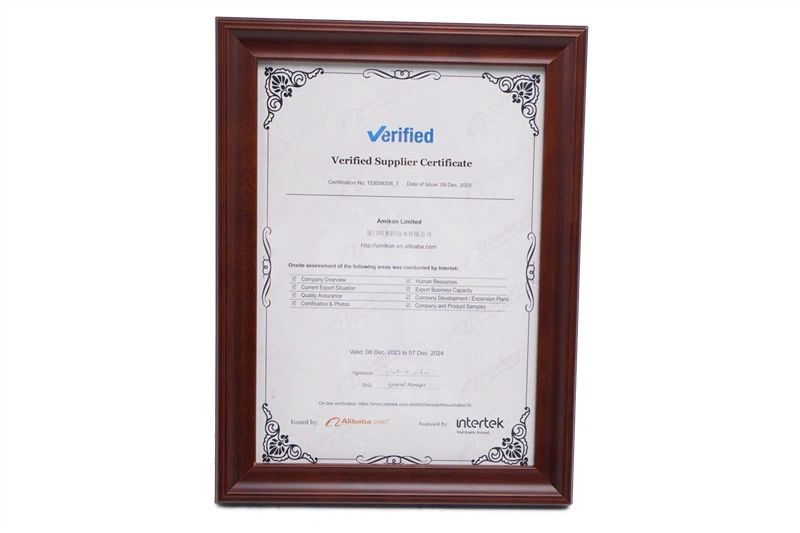
Certifications

FAQ
As one of the leading it i o module manufacturers and suppliers, we warmly welcome you to wholesale discount it i o module from our factory. All our products are with high quality and competitive price.