

Bently Nevada probe housing selection
21000 and 24701 are all-metal external proximity probe housing assemblies. The key choice is not only aluminum versus stainless steel: buyers must also match the probe, cable, penetration, fittings, mounting thread and hazardous-area approval encoded in the complete part number.
The Bently Nevada 21000 and 24701 families give maintenance teams external access to a proximity probe and its extension cable. This arrangement can simplify probe gap adjustment or probe replacement because the machine does not need to be opened merely to reach the sensor connection. However, two housings that look similar can have materially different construction and ordering options. An exact full catalog number is therefore essential for procurement.
This guide is based on the current manufacturer datasheet 141600 Rev. AC. It explains how to compare the two families, decode the ordering structure, avoid long-sleeve installation errors and evaluate newer housing options without assuming that they are drop-in replacements. Buyers can also review PLCLeader's Bently Nevada product range and cables and accessories category.
21000 vs 24701: the practical difference
| Selection point | 21000 | 24701 |
|---|---|---|
| Housing body | Aluminum | 303 stainless steel |
| Probe sleeve | 304 stainless steel | 304 stainless steel |
| Typical mass without fittings | 1.1 kg (2.4 lb) | 1.8 kg (4.1 lb) |
| Buyer priority | Lower-weight aluminum-body configuration | Stainless-steel body for applications where that construction is specified |
| Ordering principle | Verify every suffix field and the required approval; the family number alone is not enough. | |
The material difference is important, but it does not by itself determine suitability. A correct housing must also fit the machine case, reach the target safely, accept the intended reverse-mount probe and match the site wiring and conduit arrangement. The 24701's greater typical mass is consistent with its stainless-steel body; it should not be interpreted as an electrical performance difference.

Example 21000 housing configuration. Always use the complete catalog number when matching an installed unit.
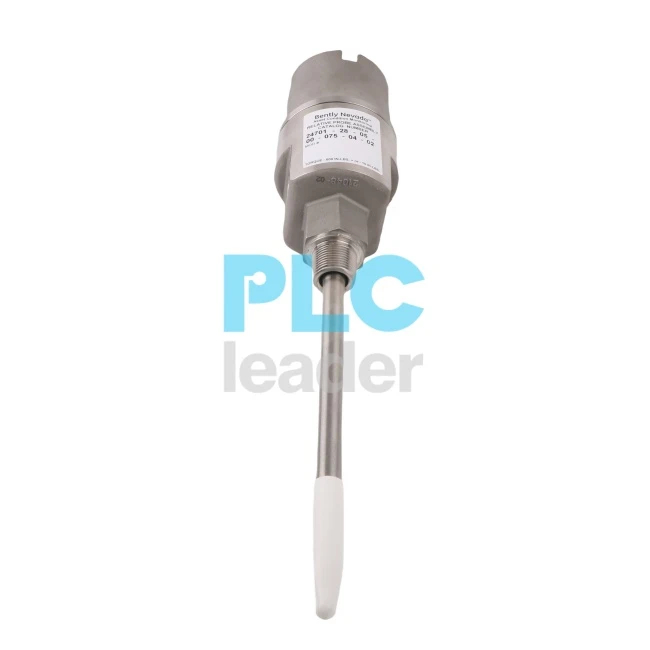
Example 24701 stainless-steel housing configuration.
What is included in a housing assembly?
Depending on the selected ordering options, the assembly is built around a dome cover that screws into the housing body, threaded conduit ports, an optional-length probe sleeve, O-rings, a reverse-mount proximity probe and a thread seal. Optional conduit fittings and an optional standoff adapter complete the installation-specific configuration.
The housing is a mechanical and environmental mounting solution; it is not the entire measurement chain by itself. The probe type, cable length and matching monitoring electronics remain part of the system-level selection. When a buyer requests only "21000 housing" or "24701 housing," the request is incomplete unless the replacement is being matched to a verified nameplate or previous order record.
How to choose the correct family
1. Confirm the specified body material
Select 21000 when the documented configuration calls for an aluminum body. Select 24701 when the machine design or plant specification requires the 303 stainless-steel body. Both use a 304 stainless-steel sleeve. Do not substitute one body material for the other solely because the mounting dimensions appear similar.
2. Confirm the probe system and temperature limits
The official environmental data is tied to the selected probe. For 3300 XL 8 mm and 11 mm probes, the stated operating and storage range is -51°C to +177°C (-60°F to +351°F). For the 3300 NSv probe, the operating range is -34°C to +177°C (-30°F to +351°F), while the storage range is -51°C to +177°C. The manufacturer also cautions that exposing 3300 XL or 3300 NSv probe pressure seals below -34°C (-30°F) may cause premature failure. Engineers should evaluate the probe, housing location and process conditions together instead of applying a single generic temperature rating to every assembly.
3. Verify the hazardous-area requirement
21000 and 24701 assemblies are available in hazardous-area configurations and are compliant with API 670 for externally mounted proximity probe housings. CA21000 and CA24701 are CSA explosion-proof versions for eligible North American end users, subject to the permitted probe and fitting combinations. Approval is configuration- and destination-dependent. A housing, probe and cable combination must be checked as a complete approved system; a familiar prefix is not sufficient evidence of compliance.
Decode the complete ordering code
The basic catalog structures are 21000-AA-BB-CC-DDD-EE-FF and 24701-AA-BB-CC-DDD-EE-FF. Each field changes a physical or certification-related detail:
- AA - probe with connector: identifies the reverse-mount probe type and, where applicable, connector protector and approval option.
- BB - probe cable length: must be long enough for the selected sleeve and installed routing.
- CC - standoff adapter length: specifies no adapter or the required spacing from the machine case.
- DDD - probe penetration: determines how far the probe assembly reaches into the machine.
- EE - fittings: options include no fittings, an explosion-proof fitting with plug, two explosion-proof fittings, a reducer/seal-grip arrangement, or a plug only.
- FF - mounting thread: available choices include as-cast without threads, 3/4-14 NPT, 1-11 1/2 NPT, 1/2-14 BSP and 7/8-14 UNF-2A, subject to family and approval restrictions.
For a practical example, review the site listings for 21000-28-05-00-092-03-02 and 24701-34-05-30-036-04-02. These are examples only; they should not be treated as universal replacements for another suffix combination.
Installation cautions that prevent repeat failures
Long-sleeve rule:
The probe lead must be longer than the sleeve. When the combined standoff and penetration dimension, or the effective probe penetration, exceeds approximately 300–304 mm (12 in), support the sleeve near the probe to prevent resonance. P/N 37948-01 is the probe support/oil seal recommended for sleeves longer than 305 mm (12 in).
Also verify that the probe can be gapped through the available adjustment range, the cable can be routed without excessive bend or tension, and the conduit fittings match the site sealing plan. For short penetration dimensions, machine-case counterboring may be necessary to reduce probe side-view or rear-view effects. That decision belongs in the mechanical installation review, not at the purchasing stage after the order code has already been fixed.
Are 31000/32000 direct replacements?
The manufacturer identifies the newer 31000/32000 proximity probe housing assembly as offering more flexible mounting, better environmental resistance and other improvements. It is recommended for installations where an explosion-proof housing is not required. That recommendation does not make every 31000 or 32000 configuration a drop-in replacement for a 21000 or 24701 assembly.
Before changing families, compare the mounting thread, housing and sleeve dimensions, standoff and penetration requirements, probe type, probe cable length, fittings, environmental exposure and approval basis. If installation space is the dominant constraint, the 164818 compact proximity probe housing is another manufacturer-listed option, including configurations for space-restricted applications. A change in housing family may require mechanical, wiring or certification review even when the measurement function remains similar.
Lifecycle and replacement status
The current manufacturer datasheet 141600 Rev. AC includes both the 21000 and 24701 ordering families. No discontinuation date should be inferred from the presence of newer housings. Exact orderability can still vary by suffix, approval and destination, so buyers should request confirmation against the full part number. If a legacy suffix is unavailable, the replacement review must be based on dimensional and system compatibility rather than a shortened family name.
What to send for a faster RFQ
- The complete 21000, CA21000, 24701 or CA24701 catalog number.
- A clear nameplate photo and, if possible, photos of the installed mounting and conduit arrangement.
- Probe type, connector/approval option and probe cable length.
- Standoff length, penetration dimension, fittings and mounting thread.
- Machine model, measurement purpose, area classification, destination country and required quantity.
- Whether the request is an identical spare or a proposed upgrade to 31000, 32000 or 164818.
PLCLeader can review the supplied order code against the requested configuration. Availability, product condition, lead time and approvals must be confirmed for the exact full part number before order placement.
Frequently asked questions
Need an exact housing match?
Send the complete part number, nameplate photo and installation requirements. PLCLeader will help identify the correct configuration and flag any points that require engineering confirmation.
Request a configuration reviewTechnical basis: Baker Hughes / Bently Nevada datasheet 141600 Rev. AC. Product names and specifications are used for identification and configuration guidance.